
Research & Development
Through industry-academia collaboration,
we aim to give back and contribute to society.
Through industry-academia collaboration,
we aim to give back
and contribute to society.
To return research outcomes to society for challenges that are difficult to solve alone,
we promote joint research with advanced research institutions.
To return research outcomes to society
for challenges that are difficult to solve alone,
we promote joint research with advanced research institutions.
The University of Tokyo × DENBA
World First: DENBA Technology Was Shown to Enhance Autonomic Nervous System Activity
In joint research with Professor Daichi Nozaki of the Department of Physical and Health Education, Graduate School of Education, The University of Tokyo, and ITOCHU Corporation, we confirmed that approximately 15 minutes of electric-field exposure using DENBA technology increased autonomic nervous system activity, including both sympathetic and parasympathetic activity.
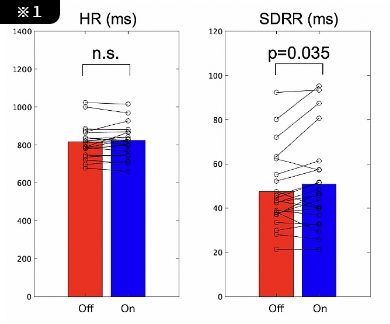
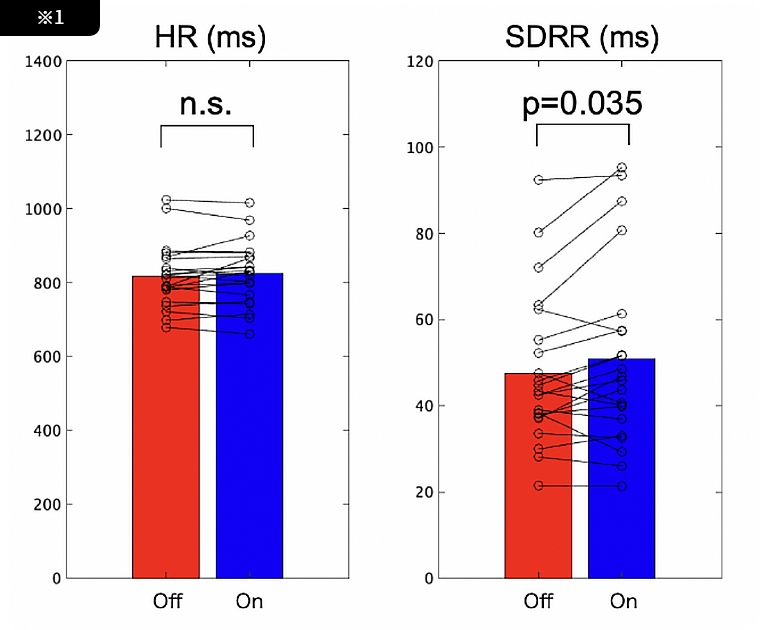
※ 1:
Effects of the electric field on HR and SDRR. SDRR significantly increased during electric-field exposure.
Overview of the Verification Study
This study focused first on the activity level of the autonomic nervous system, which is related to tension and anxiety and can also change with aging and disease. To evaluate autonomic nervous system activity, heart rate variability—the temporal variation in heartbeats—was used. The purpose of this study was to objectively verify whether short-term electric-field exposure using DENBA technology affects autonomic nervous system activity.
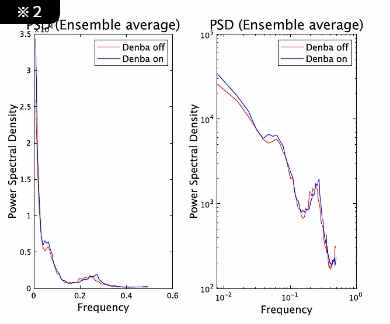
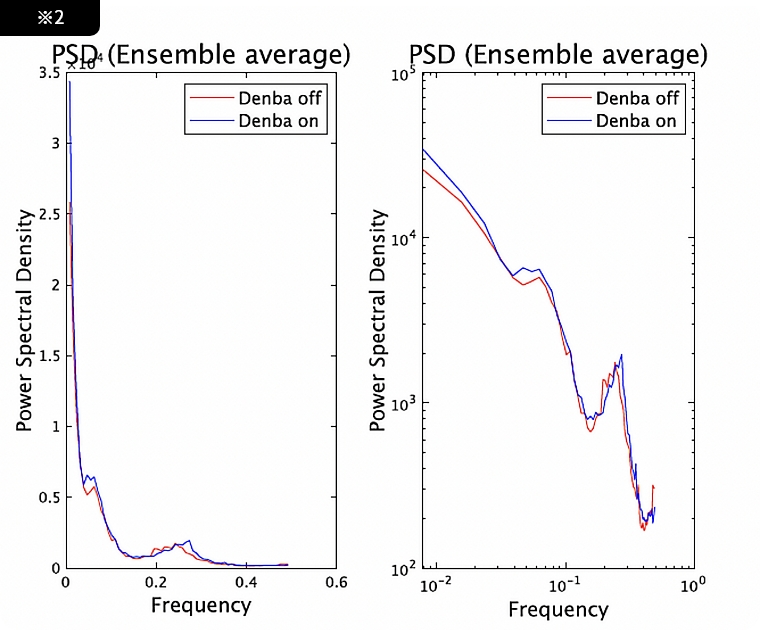
※ 2:
Power spectral density (PSD) of the RR-interval time series. The right panel is shown on a log-log scale. Overall PSD was higher under the electric-field condition.
Study Procedure
①
A total of 22 participants aged 20 to 56 sat quietly for 60 minutes on a chair equipped with a DENBA mat.
②
During this period, the DENBA switch was turned on and off every 15 minutes without the participants being able to see it.
③
The analysis used heart rate variability, calculated from variations in the time intervals between R waves (RR intervals) obtained from recorded electrocardiograms.
④
Participants were not aware at all of the switching of the weak electric field caused by turning DENBA on and off.
⑤
Nevertheless, the standard deviation of RR intervals and both the low-frequency and high-frequency components calculated from the power spectral density of RR intervals were found to increase statistically significantly during weak electric-field exposure.
⑥
Because the low-frequency and high-frequency components are considered to reflect sympathetic and parasympathetic activity respectively, it was concluded that weak electric-field exposure from DENBA is highly likely to enhance autonomic nervous system activity.
* Regarding spatial electric-field generators (as researched on September 27, 2022).
Graduate School of Education, The University of Tokyo
Graduate School of Education, The University of Tokyo

Professor Daichi Nozaki
After serving as a JSPS Research Fellow, a postdoctoral researcher in the Department of Biomedical Engineering at Boston University, and a researcher at the National Rehabilitation Center for Persons with Disabilities, he became Deputy Director of the Sports Science Initiative at The University of Tokyo. His expertise is physical education science, and he researches neural processes involved in motor control and learning.
Kamijo Women's Clinic × DENBA
Providing Solutions for Fertility Treatment Joint Research with Kamijo Women's Clinic
Definition of Declining Birthrate
A declining birthrate refers to a state in which the total fertility rate (*) falls below 2.08, the level required to maintain the population.
The total fertility rate is one of the representative indicators of population growth and represents the number of children a woman aged 15 to 45 is expected to have over her lifetime.
If this continues, the population is expected to begin declining in the future, bringing disadvantages to economic and social activity.
In Japan, where the birthrate has been declining since the mid-1970s, various measures have been implemented.
However, Japan's population peaked at 128.05 million in 2010 and is now declining.
By 2060, the population is projected to fall to 86.74 million, shrinking to two-thirds of its peak level over 50 years (*).
Ref.:
Cabinet Office, "Chapter 1: What Is the Current State of the Declining Birthrate?"
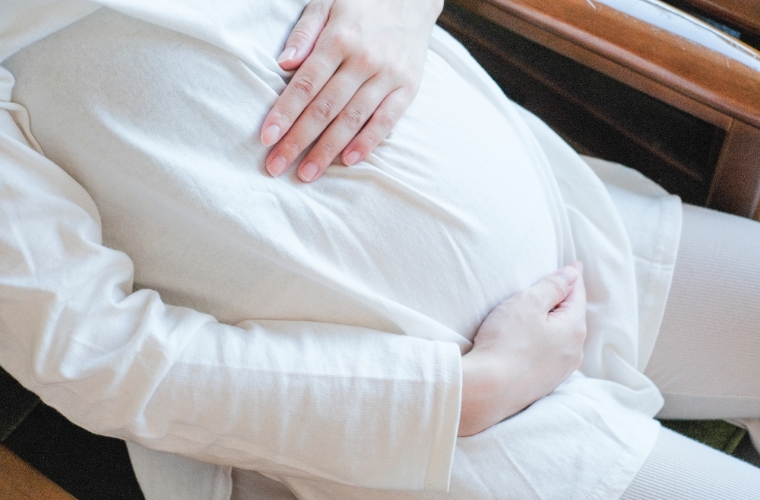
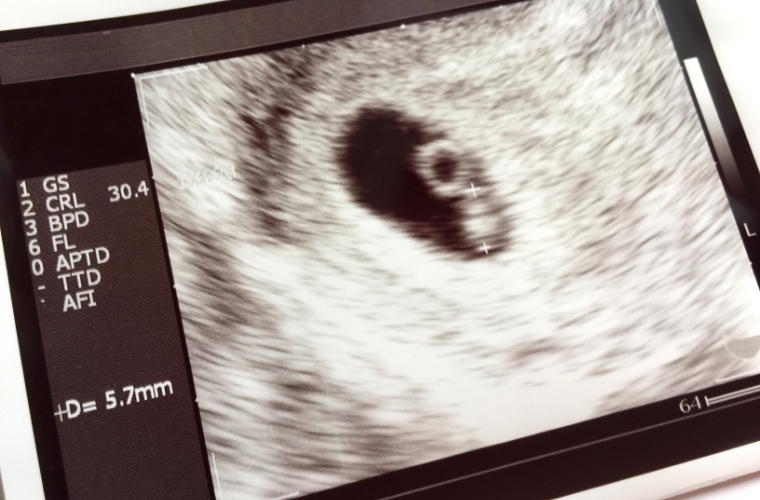
At Kamijo Women's Clinic, the use of DENBA technology for embryo culture and embryo procedures such as freezing and thawing in a DENBA environment demonstrated results that minimized damage to embryonic cells in fertilized eggs while bringing out the inherent potential of each egg as much as possible. Compared with the nationwide pregnancy rate of 21% and delivery rate of 15% for in vitro fertilization and embryo transfer in Japan, Kamijo Women's Clinic, using the Kamijo-style DENBA spatial culture method, reported significant improvements after introducing the DENBA environment in March 2022, with a pregnancy rate of 54% and a delivery rate of 29% per embryo transfer. For frozen-thawed embryo transfer as well, results showed increases compared with before introduction: the pregnancy rate rose from 29.1% to 38.5%, and the delivery rate rose from 14.3% to 22.0%.
To contribute to improving fertility treatment, a global and modern challenge, we will continue further research and evaluation using the Kamijo-style DENBA spatial culture method and work to develop and promote it worldwide.
* Kamijo Women's Clinic, which provides fertility treatment, presented at the Japan Society for Reproductive Medicine (held November 9-10, 2023) that improvements to the culture environment using DENBA technology resulted in marked increases in pregnancy and delivery rates for frozen-thawed embryos.
Research Results
Among cases aged 25 to 46 who underwent frozen-thawed embryo transfer, pregnancy and delivery rates were compared in 546 cases over one year before and one year after introduction (before: 237; after: 309).
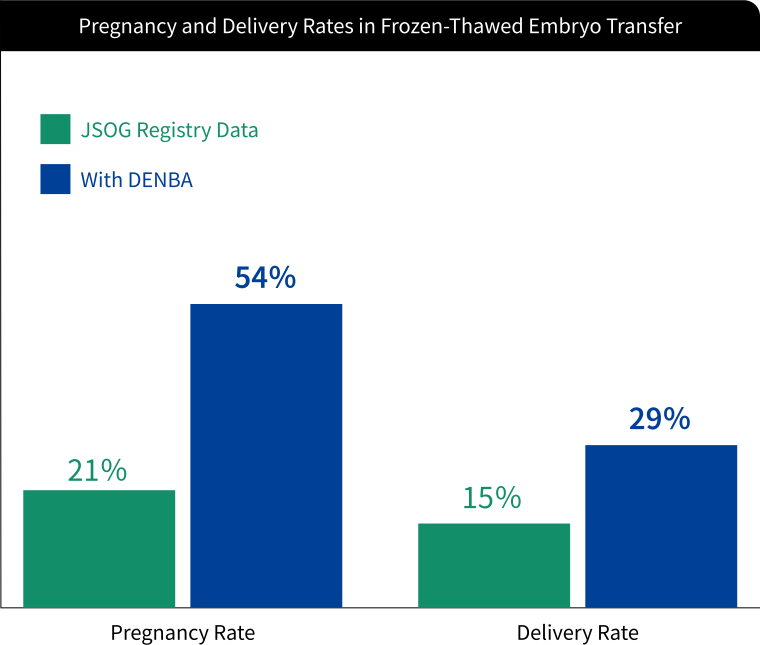
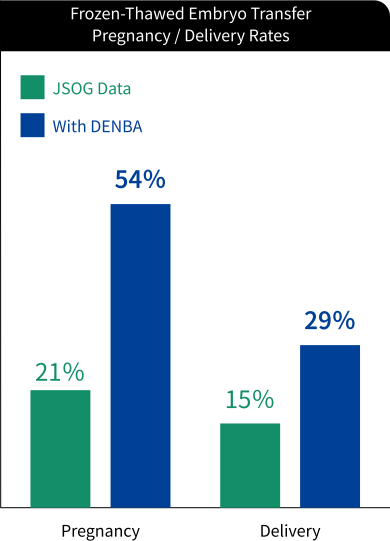
Frozen-Thawed Embryo Transfer in a DENBA Environment Showed Significant Improvements in Pregnancy and Delivery Rates.
Frozen-thawed embryo transfer in a DENBA environment showed significant improvements in pregnancy and delivery rates.

Pregnancy Rate
29.1%
⇒
38.5%

Delivery Rate
14.3%
⇒
22.0%
Also applied to embryo culture for fresh embryo transfer in in vitro fertilization (IVF-ET).
* Pregnancy and delivery outcomes for 300 IVF-ET cases conducted from March to December 2022.